On WIPCE and value
Wāhine Māori work for free until xmas... haven't you heard?

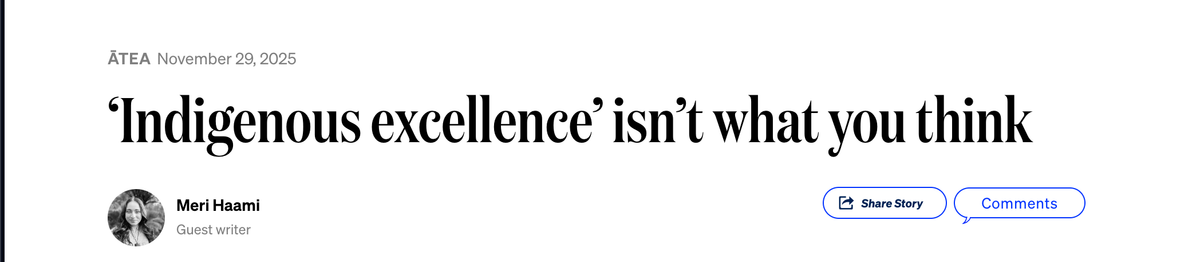
I recently wrote an article for The Spin-off regarding my thoughts on WIPCE. You can view it here:
After a few days of not advertising this article out of spite, I talked to my whānau and friends about why. I then decided to be open about my irritations by complaining on my Instagram story (I know, a very hilarious place to do that) that I had not been paid for this article. I found out after the submission of this article that I was meant to be paid. I took the opportunity to release and warn others - especially wāhine Māori - to not work for free. This was a good reminder to always ask first if it is paid work and not to assume that the Māori editor would act in good relation.
He whakaaro ōu
I received a number of interesting comments and responses on my story that struck me. I want to probe these further:
- "I know this [insert editor]". Many people who follow me had proximity to the editor as if that somehow mitigated their behaviour. I too have relations and friends who are not nice to some and who are nice to others. I do not believe anyone is ever that consistent with everyone (and that is okay). Sometimes it comes down to people not liking you and this is also okay. I can always accept that I may not be well liked.
- "Did you push back/will you push back?" If your first initial response is to relegate my mistreatment as my own individual fault, I may need you to think more critically about structural and institutional power as well as racism and sexism. I think this situation goes beyond my 'individual willingness' to respond, but is rather about the structural and institutional barriers that do not enable me to get paid as a wahine Māori. For example, The Spin-off is independent journalism and I imagine under the structures of our right-wing government that journalism is not a well funded and prosperous field to be in right now. From this thinking, paying me might be hard. However, the expectation that they did not need to pay me is where they are at fault as they have paid other Māori contributors prior, thus setting a precedent. Returning to the first point, this editor or other editors, just may not like me (that is possible and okay!). Additionally, the editing process was strange. I was questioned about whether I could write non-academically and whether I knew how grammar worked. This position is quite rife in creative writing circles but is mostly predicated on a bedrock of envy for academic qualifications. So what then? How does one respond when the inter-personal interactions are already sour?
- "Did you think about [insert suggestion]?" So with my Instagram stories (the regular ones) and any complaints I might share on there - it's likely that I have talked with my irl whānau and friends; shared voice notes with friends and relations; and talked on close friends about my issue. In this way, a lot of prior thought has gone into my complaints and with it, a lot of filtering from whakaaro of those closest to me. So I hate to break it to you, but if you are offering suggestions (which I did not ask for) and you are reading my complaints on my regular stories; you are the last to hear about it. Generally, unless someone asks for suggestions when I watch other people's stories, I might offer something. But I rarely do unless I know I'm close to that person irl. So I find it strange that when I don't ask for whakaaro, I will often get these unwarranted anyway and as if I hadn't thought much about my complaints.
These responses I received speak more to the way others perceive my value and perhaps how I should be 'resilient' in upholding my own value as a 'tough' wahine Māori. This line of thinking sees my value as more of an individual endeavour. However, some of these responses are coded with paternalism that speak more to my race, gender and age, which then highlight how its actually wider structural and societal issues that inform the way I am treated and how I am valued. I may love me, but the world is not kind to wāhine Māori who love themselves. Further, there are only so many battles you can overcome as a wāhine Māori in daily life, which can be forced upon you. So it's about being strategic with which battles are worthy of your time. Pushing back on this article was not deemed worthy enough. However, complaining, warning others who may be approached for an article in the future to reconsider their value and then initiating the kūmara vine because te ao Māori is so small - seems more strategic and in line with my time.
Something also to note - I love complaining! My complaints rarely cause huge emotional havoc in my life and if I discuss them on Instagram stories - well then, by that time - I'm over it but I still crave a form of release.
Additional tea on WIPCE
I believe the article is fine. I do not think I say anything truly extraordinary but I was able to distill what I witnessed during the conference. I do believe I should have been compensated however. Here are some additives that were edited out due to word count:
The World Indigenous Peoples’ Conference on Education (WIPCE) returned to Tāmaki Makaurau, Aotearoa being hosted by the lands and waters of Ngāti Whātua Ōrākei from the 16-20th November 2025 after 20 years. In its opening keynote by Distinguished Professor Linda Tuhiwai Smith, she deconstructed the phrase, ‘Indigenous excellence’, opting to say (and I’m paraphrasing here), “they told me to talk about Indigenous excellence… but I’m not very passionate about that.” From here, Linda asked us to be aspirational, envisioning and re-imaginary about ‘Indigenous excellence’ by thinking intergenerationally: how can our mokopuna (grandchildren; descendants) be well? Her keynote set the tone of the conference where Indigenous peoples’ from everywhere - past, present and future – all gathered, shared and proved their own metrics of what ‘excellence’ means for their communities, places and future generations.
I find it wild that the conference gave thee Linda Tuhiwai Smith the keynote theme... bro I think she will decide. The person who wrote Decolonizing Methodologies: Research and Indigenous Peoples (2021) should really be the person to decide and set the tone of an Indigenous education conference. Linda spoke wonderfully as usual by pausing us to really think about the phrase ‘Indigenous excellence’ and return us to intergenerational thinking around ‘success’. This idea of success is an Indigenous way to see the world and is compellingly covered in her book through the listing of Indigenous projects and Kaupapa Māori research (Smith, 2021).
The general tone of WIPCE throughout its speakers and delegates was beautiful. Here's my observation about this:
WIPCE reaffirmed why Indigenous focused gatherings are vital and that these spaces need to be supported. The official WIPCE2025 social media campaigns showcase various interviews of Indigenous peoples’ everywhere talking about how their mana (prestige) and spirits were enhanced by such a gathering carried out by Indigenous peoples.
What I did like about WIPCE was being able to be human as an Indigenous person; something we are actually rarely afforded. This was most recognisable through our ability to in-fight openly but in a way that this was not sensationalised. We were allowed to be critical as Indigenous peoples about ourselves and as conferences delegates, which allows us to be human:
As I point out these challenges, I do so with hope, love and with gratitude, because as a wahine Māori (Māori woman) and an Indigenous person, how often do we get to have these hard-hitting discussions amongst ourselves? Hardly ever! It is strangely refreshing to not have to worry about the optics of ‘in-fighting’, which shows the power of WIPCE in being a forum that allows us to be Indigenous. With that frame, WIPCE allows us as Indigenous peoples to be be human who challenges, fights, reconciles and shares knowledge with their communities. The next WIPCE will be held in Waikōloa, Hawai’i and with it, it carries the challenges, joys and pursuits of Indigenous peoples for being well within education.
Ko taku whakaaro
Ka nui te mihi ki a kautau mō tō kōrero i ngā awhi. Thank you to all those who reached out offering affirmation that not being paid as a wahine Māori for your insight indeed sucks! Thanks to those who just sent their aroha. Thank you to those who read the article and enjoyed it (even though I think its okay at best haha).
However, in aligning with my article and in echoing the kōrero of Ani Mikaere and Linda Tuhiwai Smith, WIPCE displayed the dangers of re-producing colonialism in the conference setting and in the term 'Indigenous excellence'. This was especially harmful for the Māori organisers who were not allowed to be Māori on whenua Māori during the conference. The Māori organisers did not have the same freedom as conference delegates or speakers like myself to be critical of the way in which the conference was managed. I have a lot of aroha for them. They held the space and mauri as Māori and they did the best they could despite being undervalued. They held that space so that Māori could feel represented enough to attend.
Just as I was not compensated for my insights or time as a wahine Māori and a Kaupapa Māori researcher for the article (which also became neutralised in the editing process but I digress), WIPCE did not seem to value its Māori organisers enough either. This unfortunately shone through many aspects of the conference that decontextualised tikanga Māori for tokenistic uses. Again, it comes back to Linda's opening keynote - why not contort what we think is 'legitimate' and actually just re-imagine what we want? Why can't we re-envision to make it work for us as Indigenous peoples so that we can be well? By whose metrics are we adhering to?
Ngā rauemi
Haami, M. (November 29, 2025). ‘Indigenous excellence’ isn’t what you think'. The Spin-off. https://thespinoff.co.nz/atea/29-11-2025/indigenous-excellence-isnt-what-you-think
Smith, L. T. (2021). Decolonizing Methodologies: Research and Indigenous Peoples. 3rd Edition. Zed Books.